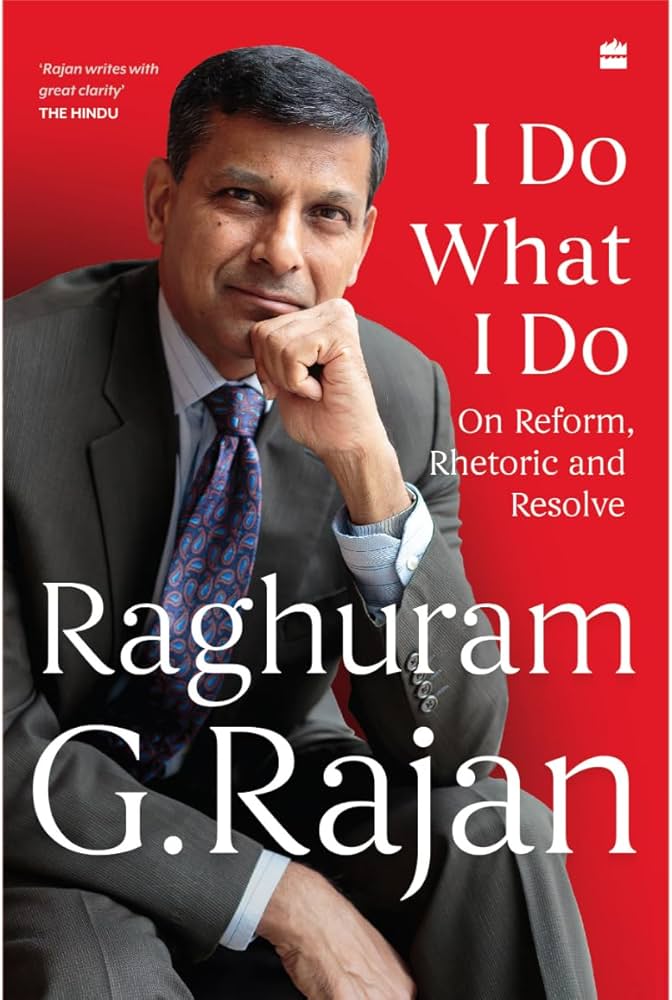
The Dosa Test & The $26 Billion Gamble: 4 Surprising Economic Lessons from Raghuram Rajan
Raghuram Rajan earned a reputation as a “rock star” central banker—an image he tried to downplay—a candid and often unconventional thinker who departed from the typical bureaucratic mold. His book, “I Do What I Do,” compiles the speeches from his tenure, offering insights that go far beyond monetary policy to reveal surprising truths about India’s economy, its challenges, and its path forward. But his goal wasn’t just to set the record straight; he hoped to “give the youth of the country a feel for the excitement of working at the central bank” and attract a few into the vital fields of economics and finance. This article distills four of the most impactful and counter-intuitive lessons from his time at the helm of the Reserve Bank of India (RBI).
The ‘Dosa Test’ — How Lower Interest Can Make You Richer
A common complaint Rajan received from retirees was that they were earning less on their deposits (e.g., 8%) than they used to (e.g., 10%). To address this, he gave way to his “inner teacher” and introduced a simple concept he called “Dosanomics” to explain the crucial difference between nominal and real interest rates.He argued that if inflation falls faster than the interest rate on a deposit, the saver’s actual purchasing power increases. For example, if deposit rates fall from 10% to 8%, but inflation falls from 10% to 5.5% in the same period, a saver is actually better off. Their nominal return is lower, but the real return—the number of dosas their money can buy—is higher. This is a crucial, counter-intuitive point: true wealth is measured by what your money can buy, not by the nominal interest rate number on a bank statement.
The $26 Billion Gamble That Saved the Rupee
Shortly after taking office during the 2013 currency crisis, Rajan implemented a bold Foreign Currency Non-Resident (FCNR) deposit swap scheme. Initially, he was skeptical, dismissing it as “yet another clever ploy by bankers to get a subsidy from a country in trouble.”However, his perspective shifted after a stark “balance of risks” analysis. He weighed the potential costs of the scheme against the catastrophic damage of a continued rupee collapse. His calculation was visceral: if the rupee continued its free fall, “every one-rupee rise in the dollar-rupee rate would costs us Rs 40,000 crores more in import costs,” leading to a potential “loss of lakhs of crores to national income.” In contrast, the scheme’s maximum payout “would only be in the tens of thousands of crores.” He took the measured risk.The gamble was a resounding success, drawing in $26 billion, stabilizing the currency, and allowing the RBI to cover its forward swaps cheaply as confidence returned. It was a masterclass in high-stakes decision-making.Policy making invariably involves taking measured risks in the face of uncertainty, for one has neither a prior template nor the luxury of indecision.
Why India Has ‘Sick Companies But No Sick Promoters
‘Rajan identified a deep-seated problem in the Indian banking system: the skewed power dynamic between banks and large, influential borrowers. He observed that too many large promoters treated bank loans as junior to their own equity, insisting on a “divine right to stay in control” even when their ventures failed and they were unwilling to invest more of their own money.This led him to memorably state that India had “many sick companies but no ‘sick’ promoters.” He recounted a telling anecdote about a banker who, upon discovering a promoter had diverted funds, was incredibly angry. Yet, the most severe action the banker felt empowered to take was to cut the promoter’s credit line by a mere 20%. Rajan’s reaction: “I did not know whether to laugh or cry.” This story highlighted the systemic helplessness of lenders and revealed that a core challenge in the banking system wasn’t just bad loans, but a power imbalance that socialized losses while privatizing gains.
Why Tolerance and Respect Are Economic Necessities
In a departure from typical central banking topics, Rajan argued that social values like tolerance and respect are not just moral ideals but are essential for economic progress. In a speech at IIT Delhi, he explained that for a country at the “production possibility frontier,” sustained economic growth comes from innovation and new ideas, what economists call “total factor productivity growth.” Once catching up is no longer an option, he argued, “the only way to grow is to innovate and be even better than others in the world.”This “idea factory,” he argued, can only function in a competitive marketplace for ideas. Such a marketplace requires protecting the right to question, challenge, and debate authority and tradition in an environment of mutual respect. He warned that a quick resort to bans based on “hurt sentiment” could chill this essential debate, stifling the very innovation a country needs to advance.Far from being a foreign concept, he rooted this principle deep in India’s own history. He noted how “Raja Raja Chola, in building the magnificent Brihadeeswara Shaivite temple at Thanjavur, also incorporated sculptures of Vishnu as well as the meditating Buddha,” and how Emperor Akbar “was only following older traditions of our Hindu and Buddhist kings, who encouraged and protected the spirit of enquiry.” A vibrant, open society is a direct prerequisite for economic dynamism.The golden rule of conduct is mutual toleration, seeing that we will never all think alike and we shall always see Truth in fragments and from different points of vision.— Mahatma Gandhi
Conclusion: Beyond the Balance Sheet
Raghuram Rajan’s tenure was defined by thinking that transcended the typical duties of a central banker, tackling deep-rooted structural, social, and institutional challenges. From understanding real returns and taking calculated risks to challenging skewed power dynamics and fostering a culture of tolerance, his lessons offer a richer framework for understanding India’s economic path. They reveal that the country’s future depends on more than just numbers.As India strives for sustainable growth, is the biggest challenge found on the balance sheet, or in the mindsets that shape it?
Signing off
Manivannan MP..
Leave a Reply